
Australia’s approach to cryptocurrency taxation involves a nuanced interplay between income tax and capital gains tax (CGT). As digital assets continue to disrupt traditional financial systems, understanding how the Australian Taxation Office (ATO) treats crypto transactions is crucial for investors, traders, and businesses alike. The complexity arises from the dual nature of cryptocurrencies: they can be treated either as personal investments subject to CGT or as income when earned through specific activities like mining or payments. Clear comprehension of the relevant crypto taxation rules not only ensures compliance but can significantly impact one’s tax liabilities.
In this article, we explore the essential distinctions between cryptocurrency income tax and capital gains tax in Australia. We will dissect various scenarios, from casual investing to professional trading and mining, while highlighting the latest Australia crypto regulations and providing practical insights into proper crypto tax reporting. By the end, readers will be equipped with a detailed cryptocurrency tax guide tailored to the Aussie context, helping to demystify tax on crypto earnings and avoid common pitfalls.
Understanding the Basics: Cryptocurrency Income Tax vs Capital Gains Tax Crypto in Australia
When assessing how crypto is taxed in Australia, it’s vital to differentiate between income tax and capital gains tax crypto treatments. Both are governed by the ATO, but they apply under varying circumstances depending on the nature of the crypto activity.
Income Tax on Cryptocurrency applies primarily when crypto is received as payment for goods or services, or if crypto is mined, staked, or earned through other income-generating activities. Here, the fair market value of the cryptocurrency at the time of receipt must be declared as ordinary income. This income becomes part of your assessable income and is taxed according to your individual marginal tax rate.
For example, if Alice operates a freelance business and accepts Bitcoin as payment, the value of the Bitcoin in Australian dollars when received needs to be included in her income tax return. Similarly, if Bob earns crypto rewards from staking his coins on a blockchain network, those rewards are treated as income at their market value.
Capital Gains Tax (CGT) Crypto arises when a cryptocurrency asset is disposed of. Disposal events include selling crypto for fiat currency, exchanging one cryptocurrency for another, using crypto to purchase goods or services, or gifting crypto (except to a registered charity). CGT applies to the profit — the difference between the cost base (purchase price plus additional costs) and the sale price.
For instance, Chris buys Ethereum for AUD 2,000 and later exchanges it for Bitcoin when its value rises to AUD 3,000. The AUD 1,000 gain is subject to CGT. It’s important to note that if Chris held Ethereum for over 12 months, a CGT discount might reduce the taxable gain by 50% for individuals.
Understanding when cryptocurrency income tax and capital gains tax apply is fundamental for accurate compliance. More detailed insights on this distinction can be found in guides that elaborate on income vs capital gains crypto nuances.

When Is Cryptocurrency Taxed as Income in Australia?
The Australian tax system treats cryptocurrency like income in several specific scenarios. Identifying these situations is essential for anyone receiving or earning crypto in their everyday activities.
1. Cryptocurrency Received as Payment for Services or Goods
Crypto received in exchange for property or services must be included as income at its market value at the date of receipt. This is especially relevant for freelancers, contractors, and businesses accepting crypto payments. The tax implication is that the income is taxed at the individual’s or company’s marginal tax rate, much like traditional cash income.
For example, a graphic designer receiving Dogecoin as payment must declare the AUD value of the Dogecoin at the transaction date. This principle ensures equitable tax treatment between crypto and fiat transactions.
2. Cryptocurrency Earned Through Mining or Staking
Mining new coins or earning staking rewards constitutes income from efforts rather than capital investment. Miners who actively validate transactions and add blocks to a blockchain must declare the fair market value of mined coins upon receipt as ordinary income.
Consider a miner successfully earning Bitcoin worth AUD 5,000 on the day it was mined. That amount must be reported as income, and the miner’s usual income tax rates apply. Furthermore, expenses directly related to mining operations, such as electricity and hardware costs, may be deductible, reducing net taxable income.
3. Cryptocurrency as a Form of Employee Remuneration
When employers pay employees partly or fully in cryptocurrencies, the payments are subject to income tax withholding rules. The market value of these crypto payments counts as assessable income for the employee and is included in their payment summaries.
Joshua, who receives part of his salary in Bitcoin, must include the AUD equivalent of his crypto income in his annual income tax return, consistent with conventional remuneration.
4. Cryptocurrency Income from Business Activities
If cryptocurrency trading or investment constitutes a business activity, gains could be treated as business income rather than capital gains. This change the tax treatment from CGT to ordinary income, often leading to a higher tax burden.
Regular trading, arbitrage, or operating a crypto exchange could meet the ATO’s criteria for a business, requiring income treatment of earnings.
Understanding these earning scenarios deepens insights into cryptocurrency income tax in Australia.
How Capital Gains Tax (CGT) Applies to Crypto Transactions in Australia
Capital Gains Tax represents a major component of the Australia’s crypto tax regime, particularly for investors holding digital assets. The ATO classifies cryptocurrencies as property, placing crypto disposals within CGT events.
1. What Constitutes a CGT Event?
Several actions trigger CGT when dealing with crypto:
- Selling cryptocurrency for fiat currency
- Exchanging one cryptocurrency for another
- Using cryptocurrency to buy goods or services
- Gifting cryptocurrency (exempt if to a registered charity)
Each trigger requires calculating the capital gain or loss as the difference between disposal proceeds and the cost base.
2. Calculating Capital Gains or Losses
The cost base includes not only the purchase price but also transaction fees and acquisition costs. When disposing of the asset, the proceeds reflect the market value at the time of sale or exchange.
For example, Sarah purchased Litecoin for AUD 3,500 including fees. She then uses Litecoin to buy computer equipment valued at AUD 5,000. Since this is a CGT event, she calculates her gain as AUD 1,500 subject to CGT.
3. CGT Discounts and Exemptions
Individuals and trusts may qualify for a 50% CGT discount if the cryptocurrency was held for at least 12 months. However, companies are ineligible for this discount, facing full taxation on gains.
It’s important to maintain detailed transaction records to establish holding periods and comply with requirements.
4. Record-keeping Requirements
The ATO mandates comprehensive documentation of crypto transactions including dates, values, parties involved, and purposes. Failure to keep accurate records can result in penalties and inaccurate tax reporting.
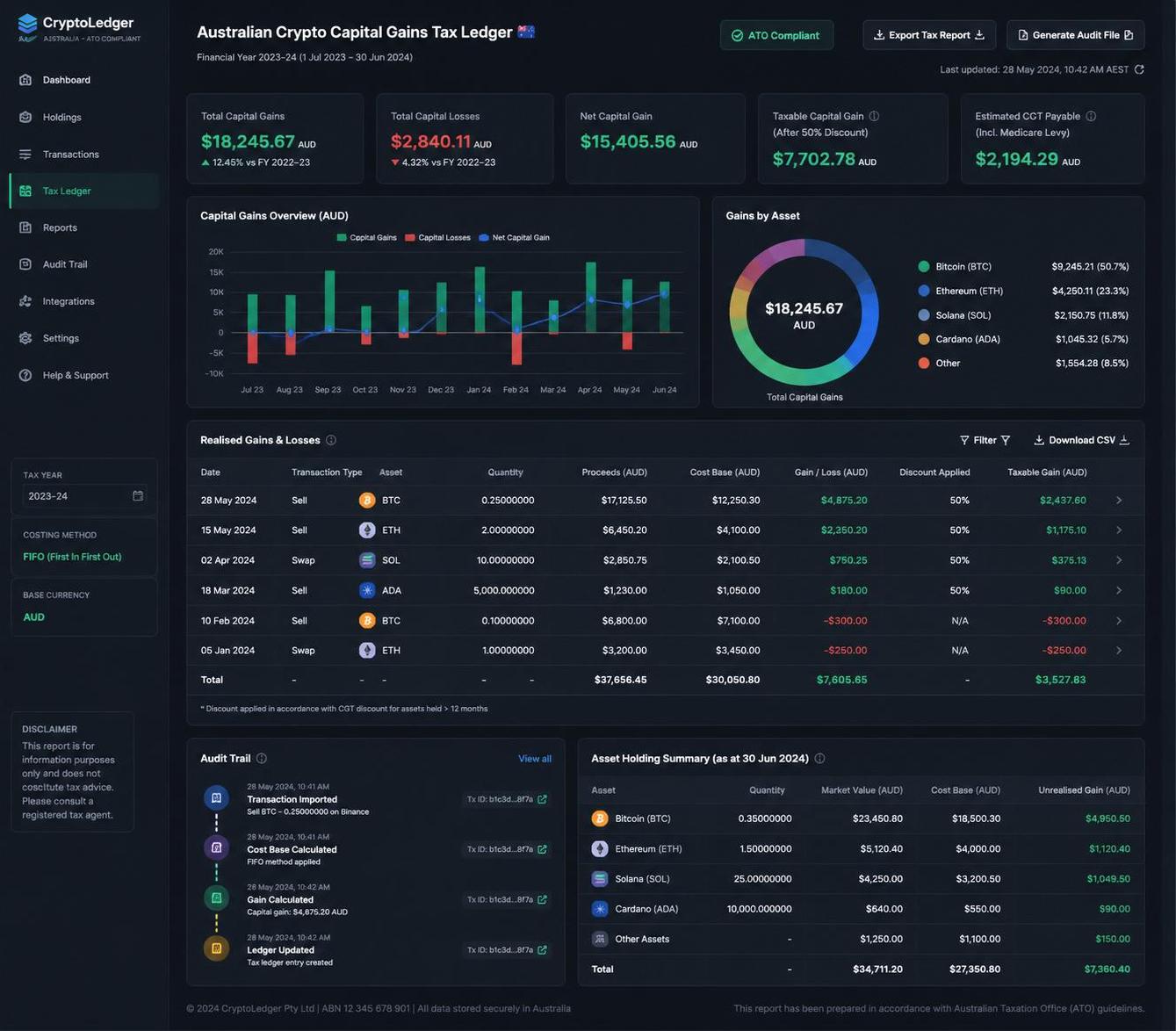
A practical outline of these record-keeping requirements and how they apply to CGT crypto can be found in the cryptocurrency tax guide dedicated to Australia.
Australia Crypto Regulations Impacting Crypto Taxation
The Australian government has actively developed regulations to clarify and enforce crypto taxation. These Australia crypto regulations aim to balance fostering innovation with preventing tax evasion and illegal activities.
1. Legal Status of Cryptocurrencies
In Australia, cryptocurrencies are considered property and are not legal tender. This classification influences tax treatment, particularly subjecting crypto holdings to CGT rather than currency exchange rules.
2. Updated Crypto Taxation Rules
The ATO continuously updates crypto taxation rules to reflect evolving market dynamics. Recent guidance explicitly clarifies situations when crypto earnings are taxed as income versus capital gains.
3. Reporting Obligations and Compliance
Crypto exchanges operating in Australia are required to share transaction data with the ATO, enhancing transparency. Taxpayers must be vigilant with their declarations due to increased scrutiny.
4. Penalties for Non-Compliance
Failure to report or under-report crypto income or gains may lead to significant penalties and interest. The ATO has issued warnings emphasizing voluntary compliance alongside increased audits.
These regulatory actions emphasize the importance of understanding the Australia crypto regulations thoroughly to ensure lawful tax conduct.
Practical Steps for Accurate Crypto Tax Reporting in Australia
Managing crypto tax reporting can be daunting, but following a systematic approach reduces errors and streamlines compliance.
1. Maintain Comprehensive Records
Track every transaction meticulously, including purchases, sales, exchanges, and income receipts. Use software tools or spreadsheets to log amounts, dates, and counterparties. Without proper records, it’s difficult to substantiate tax positions.
2. Identify the Nature of Each Transaction
Determine if a transaction is income (e.g., mining revenue) or a capital gains event (e.g., sale). This classification dictates the tax calculation methods.
3. Calculate Income and Capital Gains Separately
Ensure that income derived from crypto earnings is declared in your tax return alongside any capital gains or losses. Remember to apply the CGT discount where eligible.
4. Use Professional Crypto Tax Tools
A range of crypto-specific tax software supports automatic importing of exchanges and wallets, generating accurate reports compliant with Australian tax law.
5. Seek Professional Advice When Needed
Given the complexity and evolving nature of crypto tax law, consulting a tax specialist familiar with crypto can safeguard against mistakes and optimize tax efficiency.
Following these steps aligns closely with advice from crypto tax Australia experts and resources.
Common Mistakes in Reporting Crypto Tax and How to Avoid Them
Many taxpayers running into trouble with the ATO often make mistakes that are avoidable with proper knowledge. Awareness of these pitfalls can save time, money, and stress.
1. Confusing Income Tax with Capital Gains Tax
Failing to correctly identify if crypto earnings are income or capital gains leads to misreporting. For example, treating mined coins as capital gains instead of income can trigger audits.
2. Underreporting Transaction Values
Some taxpayers declare crypto gains at lower market values or ignore small trades, thinking they are inconsequential. The ATO’s increasing use of data matching combats these errors.
3. Neglecting Records of Crypto-to-Crypto Trades
Each cryptocurrency exchange is a CGT event, even if no fiat money changes hands. Missing this detail can cause severe underreporting.
4. Ignoring Holding Periods and CGT Discounts
Many fail to consider whether they qualify for the 50% CGT discount due to holding period requirements, inadvertently overstating tax liabilities.
5. Forgetting to Report Crypto Income From Mining or Staking
Miners and stakers often overlook the need to report their rewards as income at the time of receipt.
By avoiding these common errors and following best practices, taxpayers better comply with crypto tax reporting standards.
A Detailed Comparison Table: Income Tax vs Capital Gains Tax on Cryptocurrency
| Aspect | Income Tax | Capital Gains Tax (CGT) |
|---|---|---|
| When It Applies | Receiving crypto as payment, mining, staking, employee remuneration, or business earnings | Disposing of crypto by sale, exchange, purchase of goods, or gifting |
| Tax Calculation Basis | Fair market value of crypto at receipt included as ordinary income | Gain or loss calculated as difference between cost base and disposal value |
| Tax Rate | Marginal income tax rates for individuals/businesses | Marginal tax rate on net capital gain (50% discount may apply for individuals) |
| Record Requirements | Documentation of income event date, value, and source | Detailed records of acquisition, disposal date, proceeds, and associated costs |
| Examples | Mining Bitcoin valued at AUD 6,000, accepting Bitcoin for services | Selling Ethereum for AUD 4,000 after 18 months of holding |
Future Trends and Developments in Crypto Taxation in Australia
As of 2026, the landscape of crypto taxation continues to evolve with rapid technological and regulatory changes shaping future policies.
1. Increasing Regulatory Scrutiny
The ATO is leveraging advanced data analytics and collaboration with global tax authorities to clamp down on non-compliance. Exchange reporting requirements continue to tighten, increasing transparency and reporting accuracy.
2. Potential Changes to Tax Treatment
Ongoing debates consider whether current frameworks adequately balance innovation and taxpayer fairness, with proposals to clarify or streamline crypto tax rules in parliament.
3. Integration of Automated Tax Tools
Expect enhanced adoption of artificial intelligence and blockchain-based reporting tools to facilitate real-time compliance and reduce taxpayer burden.
4. Expansion of Educational Resources
More comprehensive cryptocurrency tax guides and public outreach by the ATO aim to increase taxpayer understanding, reducing inadvertent errors and promoting voluntary compliance.
Staying updated with these trends helps Australians remain prepared for changes impacting their crypto tax obligations.
Key Takeaways for Managing Your Aussie Crypto Tax Obligations
Navigating the complexities of crypto tax Australia brings requires careful consideration of the nature of your crypto transactions and a proactive approach to record-keeping and reporting.
Effective management involves:
- Identifying whether your crypto earnings are income or capital gains, ensuring correct tax treatment
- Maintaining accurate and comprehensive records for all transactions, including crypto-to-crypto trades
- Utilizing crypto tax software or professional advice to optimize compliance
- Understanding the Australian tax rates and eligibility for CGT discounts to properly calculate liabilities
- Staying informed on evolving Australia crypto regulations for timely adherence
Is cryptocurrency treated as income or capital gains in Australia?
Cryptocurrency in Australia can be taxed as either income or capital gains depending on the circumstances. Income tax applies when crypto is earned through services, mining, or business activities, while capital gains tax applies on disposals such as sales or exchanges.
Do I have to pay tax on crypto I mine?
Yes, the Australian Taxation Office requires that the fair market value of mined cryptocurrency at the time of receipt is declared as income and is subject to income tax.
What records should I keep for my crypto transactions?
You should keep detailed records including the date of each transaction, value in AUD, parties involved, purpose of the transaction, and receipts of purchases and sales to accurately report for both income and CGT obligations.
Can I apply a discount on capital gains tax for crypto held long-term?
Yes, if you hold cryptocurrency for more than 12 months before disposal, individuals and trusts may be eligible for a 50% CGT discount, reducing taxable capital gains.
What happens if I don’t report crypto earnings correctly?
Failure to properly report cryptocurrency income or gains can lead to ATO audits, penalties, and interest on unpaid tax. It’s important to comply and utilize accurate crypto tax reporting practices.