
As the popularity of cryptocurrency continues to surge in Australia, so does the importance of understanding the financial and legal obligations involved with such investments. Crypto investors must navigate complex tax landscapes, especially when it comes to capital gains tax (CGT). The Australian Taxation Office (ATO) treats cryptocurrencies as assets subject to CGT, meaning that profits from crypto trades are taxable. To assist investors in calculating their tax obligations accurately, various crypto capital gains tax calculators have emerged. These tools are pivotal in helping individuals comply with tax laws while optimizing their returns. This article explores these calculators in depth, examining their functionalities, relevance under current Australian tax legislation, and best practices for their use.
Key Points to Remember About Crypto Capital Gains Tax and Calculators in Australia:
- Cryptocurrencies are classified as assets, thus subject to capital gains tax under Australian law.
- Calculators simplify tax calculation by tracking purchases, sales, and applying the correct tax rules.
- Investment strategies, like holding periods and trade frequency, influence tax liabilities.
- The complexity of crypto tax laws in Australia requires ongoing diligence and accurate record-keeping.
- Several reliable online calculators integrate recent tax law changes, supporting precise tax reporting.
How Crypto Capital Gains Tax Is Applied in Australia: A Detailed Overview
In Australia, cryptocurrencies are considered property for tax purposes, rather than currency, which means that transactions involving crypto often trigger capital gains tax events. Understanding when CGT applies is critical for investors to comply legally and manage their liabilities effectively. The ATO stipulates that when an individual disposes of cryptocurrency—whether by selling it, trading for another cryptocurrency, converting to fiat currency, or even gifting—it may result in a capital gain or loss. These gains or losses must be reported on the individual’s tax return.
Calculating the tax owed involves determining the difference between the asset’s cost base—the original purchase price plus associated expenses—and the capital proceeds from disposal. If the proceeds exceed the cost base, a capital gain arises and becomes subject to taxation; if less, a capital loss is recorded, which can offset future gains.
One challenge is that each cryptocurrency transaction constitutes a separate event, requiring precise tracking of dates, amounts, and corresponding values in Australian dollars. For example, if an investor buys Bitcoin at AUD 5,000 and later sells it for AUD 7,000, the AUD 2,000 gain is taxable income. Conversely, if the sale proceeds are AUD 4,000, this results in a capital loss.
Important to note is the 50% CGT discount available to investors who hold assets for more than 12 months before disposal. This discount means only half of the capital gain is taxable, reducing the overall tax liability. However, investors who purchase and sell cryptocurrency in rapid trades or use it predominantly in business may be subject to different rules, emphasizing the necessity of clear record-keeping and understanding specific tax laws.
For those unfamiliar with tax complexities, inaccurate reporting can lead to penalties and audits. Hence, many investors turn to specialized crypto capital gains tax calculators that automatically account for multiple transactions and calculate potential taxes due.

Unlocking the Functionality of Crypto Capital Gains Tax Calculators in Australia
Crypto capital gains tax calculators play a crucial role in helping Australian investors translate their trading activities into understandable tax liabilities. These online tools automate the otherwise painstaking process of accounting for each transaction, adjusting for fluctuating asset valuations and relevant taxation rules.
At their core, calculators require the user to input detailed transaction history including purchase prices, sales amounts, dates, and the particular cryptocurrency involved. Once fed with this data, the software calculates the capital gains or losses by applying cost basis accounting methods such as FIFO (First In, First Out) or specifically identified cost bases if transaction matching is supported.
Many calculators also integrate live market data and currency conversion rates, enabling real-time valuation adjustments. This is essential in Australia where tax calculations must be reported in Australian dollars (AUD). For instance, if an individual bought Ethereum in USD and sold it months later, the capital gain would be calculated based on the AUD values at transaction times, reflecting currency exchange impacts.
These calculators also track asset holding periods and apply relevant CGT discounts or concessions automatically. By including such features, they help investors avoid errors such as forgetting the CGT discount or misapplying asset valuation. Additionally, the calculators generate detailed reports that users can directly submit to the ATO or forward to their accountants, streamlining tax filing.
An example scenario involves an investor with multiple cryptocurrencies bought over different dates. Manually tracking capital gains across such a portfolio is difficult and error-prone. By uploading transaction history, the calculator quickly offers a consolidated tax picture: the taxable gains, losses, and net capital gain after applying discounts.
Considering the dynamic nature of crypto markets and tax regulations in Australia, investors should utilize calculators that are kept up to date with current tax laws. Many providers offer subscription models for ongoing updates and support, which is beneficial during tax seasons or amid legislative changes.
The Intricacies of Cryptocurrency Investment and Capital Gains Tax Calculation
Investing in cryptocurrency carries a unique set of considerations relating to capital gains tax that differ significantly from traditional investment assets. Australian investors need to appreciate these subtleties to strategize their portfolios effectively and meet tax obligations without surprises.
A core complexity arises from the sheer volume and nature of crypto transactions. Unlike stocks, cryptocurrencies can be used for purchases, exchanged into other tokens, or involved in decentralized finance (DeFi) activities, each of which may create a taxable event. For example, using Bitcoin to purchase a product is treated as a disposal, requiring the investor to calculate a capital gain or loss on the amount equivalent to the cost of goods in AUD.
Similarly, swapping one cryptocurrency for another is also recognized as a disposal for CGT purposes. This leads to a challenging scenario for investors engaged in frequent trading or crypto arbitrage, as every trade must be tracked and reported individually.
Another critical component is the valuation of crypto assets at the point of each transaction. Due to price volatility, even holding a single token over a short period can result in differing tax liabilities depending on AUD exchange rates at purchase and sale. This underscores the importance of meticulous record-keeping and using specialized tax calculation tools rather than estimations.
To illustrate, consider an investor who buys 1 Bitcoin at AUD 20,000 and later trades it for an equivalent value in Ether when Bitcoin’s price has risen to AUD 30,000. The trade triggers a capital gain of AUD 10,000, potentially taxable unless the investor holds the original crypto long enough to qualify for the discount, or other exceptions apply. These nuances highlight why understanding asset valuation and timing is vital in crypto taxation strategies.
Furthermore, accounting for transaction fees and other costs associated with trading is essential as they can be included in the cost base, reducing taxable capital gains. The complexity involved often makes manual calculations impractical, reinforcing the need for reliable calculators tailored to crypto taxation in Australia.
Step-by-step Guide to Utilizing a Crypto Capital Gains Tax Calculator Effectively
To benefit fully from a crypto capital gains tax calculator, investors need to approach the process systematically. This ensures accuracy and compliance with tax laws while optimizing potential tax benefits.
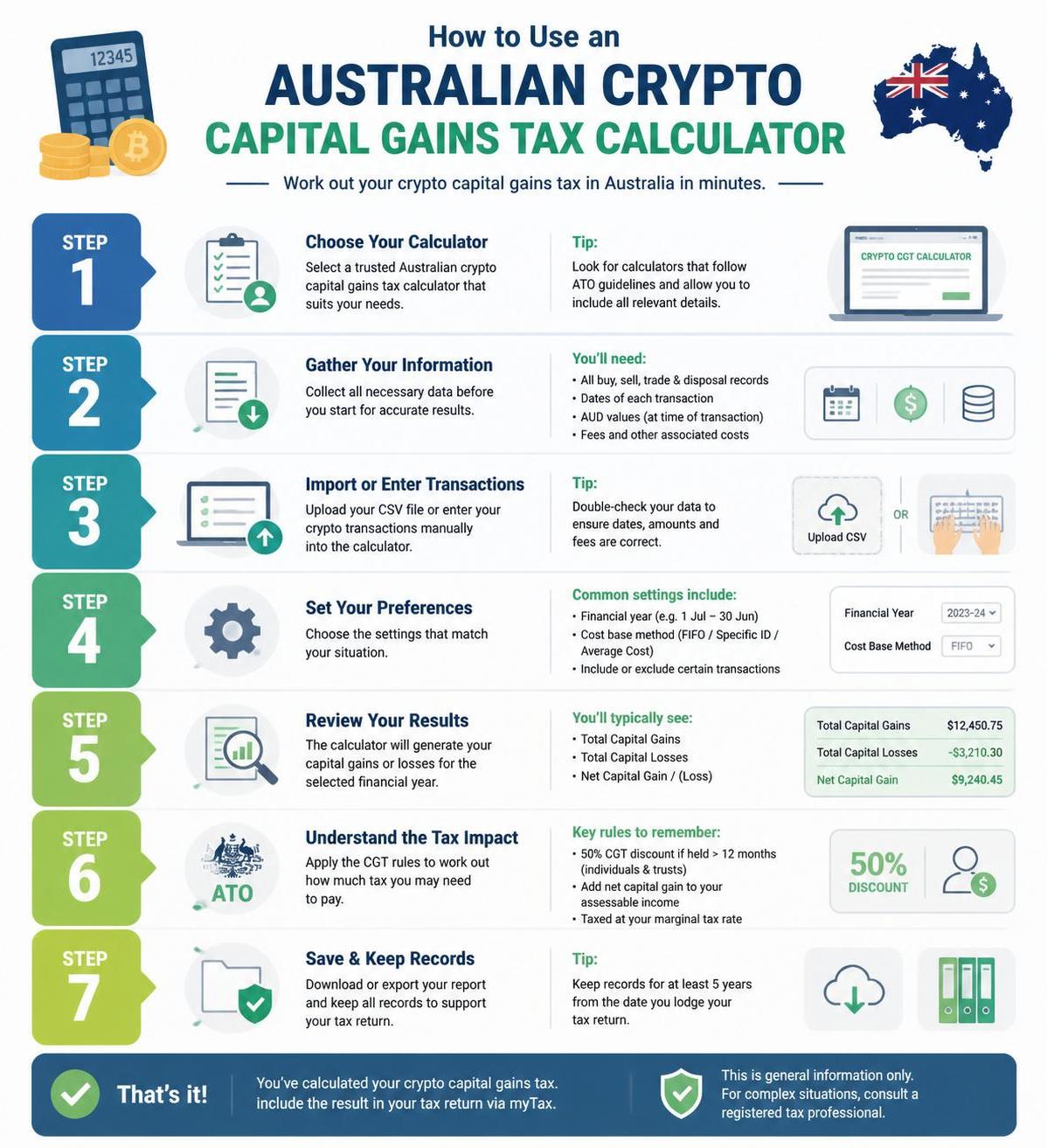
Step 1: Gather Complete Transaction Records
Collect all details of crypto transactions including buy/sell dates, amounts, prices in AUD, and any related fees. This data completeness is foundational for an accurate calculation.
Step 2: Choose the Right Calculator
Various calculators exist, some specialized for Australian tax regulations. Select one that supports detailed import formats and is updated for the latest tax legislation.
Step 3: Import Data and Select Accounting Method
Import your transaction history as per the calculator’s accepted formats (CSV, Excel, etc). Choose a cost basis accounting model like FIFO or specific identification, depending on your record precision and preference.
Step 4: Review Preliminary Results
Analyze the initial capital gains or losses output for obvious discrepancies or missing data. Cross-check with your records for consistency.
Step 5: Apply Discounts and Deductions
Ensure the calculator applies CGT discounts where eligible, and include transaction fees or expenses into the cost base adjustments.
Step 6: Generate Reports
Use the calculator to produce detailed statements listing all taxable events. These reports are essential for tax return preparation or accountant consultation.
Step 7: Update Annually
Crypto markets and tax laws evolve rapidly. Keep your calculators and records updated for subsequent tax years to avoid compliance issues.
By following these steps, Australian investors can streamline tax calculation, reduce the risk of errors, and improve financial planning related to their crypto assets.
Exploring Australian Tax Laws Related to Crypto Capital Gains Tax and Reporting Requirements
The Australian government has issued specific guidance on how cryptocurrencies are treated for tax purposes, reflecting their growing prominence in financial markets. Understanding these laws is essential for investors who hope to stay compliant and make informed investment decisions.
Crypto is regarded as property under Australian tax law, which means it is subject to capital gains tax like shares or real estate. The gains or losses from disposals must be reported in the annual tax return. Additionally, if cryptocurrency is held as part of a business, different income tax rules may apply.
Crypto taxation also requires investors to maintain comprehensive records of transactions. The ATO mandates retaining transaction histories showing dates, values in AUD at the time, and details of the party involved for a minimum of five years after filing an income tax return that declares the gains.
Failing to comply with these regulations can attract penalties, interest, or audits. It is therefore critical for investors to stay informed about the tax laws and update their strategies accordingly. Resources such as the ATO’s official guidance and blogs from expertise hubs provide updated interpretations and practical advice, such as this detailed overview of crypto taxation.
Also, the tax office distinguishes between personal use assets and investments. While some small transactions may be classified as personal use, most exchanges or trades involving significant value are treated as taxable events.
For instance, mining cryptocurrency introduces another layer of tax considerations as miners may need to report income from mining activities and subsequent capital gains upon disposal.
| Tax Aspect | Description | Example |
|---|---|---|
| Capital Gains Tax Event | Disposal of cryptocurrency triggering taxable gain or loss | Selling Bitcoin for AUD 10,000 when cost base was AUD 6,000 results in AUD 4,000 gain |
| CGT Discount | 50% discount on gains for assets held over 12 months | Holding Ether for 14 months before sale reduces taxable gain by half |
| Record-Keeping | Maintain transaction logs including dates, AUD valuations, and counterparties | Store exchange records and crypto wallet histories for 5 years |
Strategies to Optimize Crypto Tax Calculation and Minimize Capital Gains Tax
With a clear grasp of how capital gains tax applies to cryptocurrency in Australia, investors can adopt strategies to optimize their tax liabilities legally. Using crypto capital gains tax calculators effectively is part of this process, enabling better investment planning.
A common strategy is long-term holding to qualify for the CGT discount. By holding assets for more than 12 months, investors halve their taxable gain, potentially saving thousands of dollars. However, this requires forecasting market trends and willingness to accept volatility.
Another technique involves strategic sales to offset gains with accumulated losses. If an investor has experienced some losses in other crypto trades, these can be utilized to reduce total taxable income from gains, a process known as tax-loss harvesting. Calculators provide an overview of such opportunities by summarizing gains and losses across a portfolio.
Timing disposals toward the end of a financial year can also influence overall tax outcomes, especially if it enables shifting gains or losses into future years or altering income brackets. Tax calculators assist in simulating various scenarios, allowing investors to choose optimal dates for trading.
Investors engaged in frequent trading should be cautious as the ATO may consider their activities as running a business rather than personal investment, which changes tax treatment entirely. Thus, consulting tax professionals along with utilizing technology tools is recommended.
Additionally, accurate allocation of transaction costs and fees to the cost base ensures these are deductible, reducing capital gains. This level of detail is often difficult to do manually but easily managed by advanced calculators.
Ultimately, consistent recording, proper use of calculators, and awareness of tax laws empower investors to maximize post-tax returns and avoid penalties.
Emerging Trends and Future Directions in Australian Crypto Taxation and Calculators
As 2026 progresses, the intersection of evolving cryptocurrency markets and Australian tax regulations continues to develop. Both ATO policies and technology supporting tax calculation are rapidly adapting to meet new challenges.
One noticeable trend is the integration of blockchain analytics within tax tools, increasing accuracy in tracing transaction origins and assets movement. This capability enhances verification and compliance checks and reduces reliance on self-reported data alone.
Furthermore, there is a growing push by governmental bodies to automate tax reporting linked directly to cryptocurrency exchanges and wallets. This shift may reduce the calculation burden on investors but increases the need for robust digital record keeping.
Calculator developers are increasingly incorporating AI and machine learning to deliver personalized tax advice based on transactional data patterns. Such smart calculators could predict tax liabilities in real-time and suggest optimization strategies individually tailored to investor behavior.
Legislative efforts are also underway to clarify certain ambiguities in crypto taxation, such as defining personal use assets more explicitly and addressing the treatment of decentralized finance operations. Investors and practitioners must stay attentive to these changes as they impact how capital gains tax is computed and reported.
With technology and regulations evolving together, Australian crypto investors will likely experience more streamlined, transparent, and efficient tax processes in coming years, supported by increasingly sophisticated capital gains tax calculators.
What transactions trigger capital gains tax on cryptocurrencies in Australia?
Capital gains tax is triggered on the disposal of cryptocurrency, including selling for fiat currency, trading one cryptocurrency for another, or using cryptocurrency to purchase goods or services.
How does the 50% CGT discount work for crypto assets in Australia?
If you hold your cryptocurrency for more than 12 months before disposal, eligible capital gains can be reduced by 50%, effectively halving the taxable gain.
Can I use a traditional tax calculator for cryptocurrency tax calculations?
Traditional tax calculators often lack the specific features needed for crypto tax calculations, such as handling multiple transactions, variable asset valuations, and cost base methods. Specialized crypto capital gains tax calculators designed for Australian regulations are highly recommended.
How important is record-keeping for crypto investments under Australian tax laws?
Maintaining detailed records of all cryptocurrency transactions, including dates, amounts in Australian dollars, and counterparties, is essential, as it is required by law to support tax return claims and for possible audits.
Are there any strategies to minimize capital gains tax on cryptocurrency investments?
Yes, strategies like holding assets for over 12 months to benefit from the CGT discount, tax-loss harvesting to offset gains with losses, and strategic timing of sales can help minimize capital gains tax liabilities.